

Communication is one of the most critical drivers of project success and a key contributor to well-being at work. Yet effective communication does not happen by chance. It depends on deliberate structures, shared rules, and clear mechanisms that shape how information circulates within an organization.
Before exploring different team structures, it is essential to clarify a few foundational concepts. These notions help us understand how organizational structures emerge and how, over time, they influence corporate culture. The first and perhaps most fundamental of these concepts is communication flow.
Within an organization, informations do not move in a single direction. It follows multiple, often overlapping paths:
- Downward, from leadership to teams
- Upward, from teams to leadership
- Horizontal, between peers or functions
- Diagonal, across levels and departments
- Hub, where communication is centralized through a person, role, or system that acts as a coordination point

In addition, each of these flows can be formal, embedded in defined processes and hierarchies, or informal, emerging organically through day-to-day interactions. Understanding how these flows operate, and where they break down, is a prerequisite for designing effective teams and resilient organizations.
Downward communication#

Commonly referred to as top-down communication, downward communication flows from leadership to employees. It is primarily used to transmit strategic direction, operational plans, policies, and expectations. This form of communication plays a central role in establishing clarity, consistency, and organizational alignment.
Managers rely on downward communication to translate vision into action, ensure objectives are understood, and provide guidance on execution. When well-structured, it helps reduce ambiguity and coordinate collective effort across teams.
Downward communication can follow two distinct structural patterns, depending on how information is disseminated through the hierarchy.
Direct downward communication occurs when a manager communicates the same message directly to all individuals within their span of control. Information flows from one person to many, without intermediaries. This approach is often used when speed, clarity, or message consistency is critical.
Indirect downward communication follows the hierarchical chain of command. A manager communicates with their direct reports, who then cascade the information to their own teams. This model supports scalability and reinforces managerial responsibility at each level, but it also introduces the risk of message distortion as information passes through multiple layers.
- Presenting annual or quarterly reports
- Announcing company policies or organizational changes
- Clarifying strategic objectives and priorities
- Conducting training or onboarding sessions
- Performing performance appraisals
Common communication channels:
- Memos and newsletters
- Phone or video calls
- In-person staff or all-hands meetings
- Reinforces alignment around goals, priorities, and strategy
- Facilitates delegation and coordination at scale
- Feedback loops tend to be slow or incomplete
- Often perceived as directive, which can reduce engagement or motivation if overused
Upward communication#

Also known as bottom-up communication, upward communication flows from employees to leadership. It is crucial for transmitting feedback, insights, concerns, and suggestions from teams to decision-makers. This flow complements downward communication by helping leaders stay connected to on-the-ground realities.
Upward communication empowers employees to contribute to strategy, improve processes, and highlight operational challenges. When supported and structured well, it fosters transparency, trust, and a sense of engagement.
Direct upward communication occurs when team members share feedback or report directly to leadership without intermediaries. This is often effective in small teams or when rapid input is needed.
Indirect upward communication passes information through managerial layers. Employees communicate with their immediate supervisors, who then relay relevant information up the chain. While this method organizes reporting, it carries the risk of filtering or distortion as messages pass through multiple levels.
- Providing feedback on management decisions or strategies
- Suggesting improvements to processes
- Reporting obstacles or operational challenges
- Giving project updates or progress reports
- Sharing concerns about workplace conditions
Common communication channels:
- One-on-one meetings
- Feedback forms or surveys
- Team or project status reports
- Informal conversations or town halls
- Helps leadership make decisions grounded in real experiences
- Encourages employee engagement and psychological safety
- Detects problems or opportunities early
- Messages can be diluted or altered through layers
- Employees may hesitate to speak up if the culture is not supportive
- Requires active listening and follow-up from leadership to be effective
Horizontal communication#
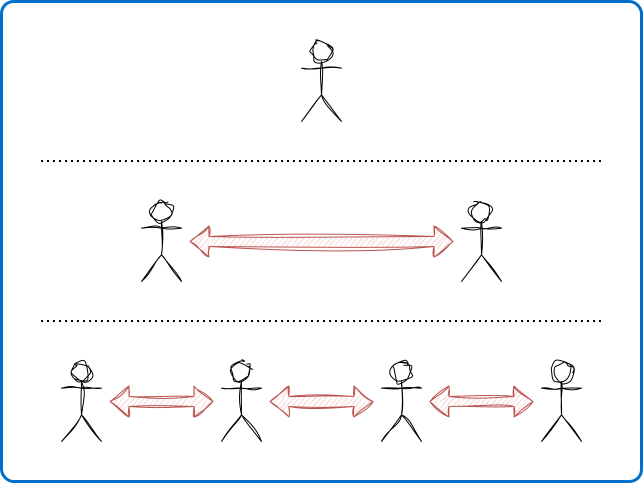
Also known as peer-to-peer communication, horizontal communication takes place between colleagues at the same organizational level. It is essential for coordination, collaboration, and knowledge sharing across teams or departments, bypassing formal hierarchical channels.
This type of communication helps break down silos, align work across functions, and foster a cooperative culture. It can be both informal, such as casual discussions, or structured, through regular cross-functional meetings and collaborative tools.
- Coordinating tasks or schedules between colleagues
- Sharing expertise or technical knowledge
- Discussing problem-solving approaches or brainstorming ideas
- Aligning deliverables across departments
- Informal conversations that clarify processes or expectations
Common communication channels:
- Team meetings or workshops
- Instant messaging platforms or chat groups
- Collaborative project management tools
- Email threads among peers
- Informal conversations or coffee breaks
- Enhances collaboration and teamwork
- Reduces misunderstandings and duplicated work
- Strengthens relationships and knowledge sharing
- Can lead to information overload if not managed
- Risk of misalignment if communication bypasses formal decision-making
- May create informal power dynamics that influence outcomes
Diagonal communication#
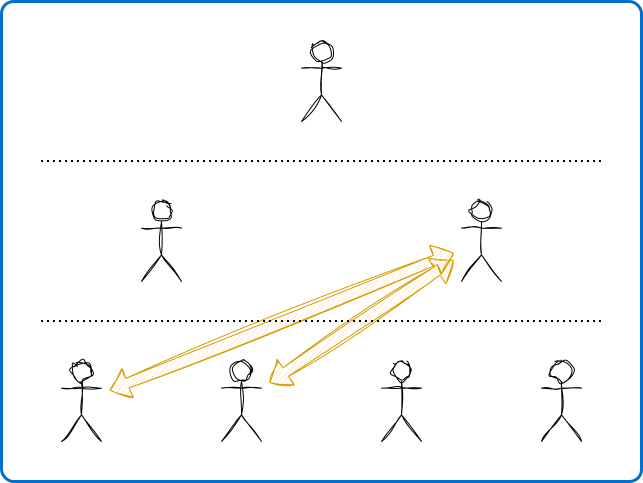
Diagonal communication occurs when messages flow across both levels and departments, connecting individuals who are neither direct supervisors nor peers. It is particularly useful for coordinating complex projects, solving cross-functional problems, and speeding up decision-making in organizations with multiple layers.
This type of communication breaks traditional silos by enabling collaboration between people who otherwise might not interact directly. It often combines formal channels, such as project reporting, with informal interactions, like cross-department discussions.
- A project manager coordinating with a team member from another department
- Employees seeking guidance from a subject-matter expert outside their direct reporting line
- Managers exchanging information with non-reporting staff to address operational issues
Common communication channels:
- Project management and collaboration tools
- Cross-department meetings or workshops
- Email or messaging across teams
- Informal discussions or networking sessions
- Cross-functional task forces
- Accelerates problem-solving and decision-making
- Enhances collaboration across departments and levels
- Helps organizations respond more flexibly to challenges
- Can create confusion if roles and responsibilities are unclear
- Risks bypassing formal authority, potentially causing tension
- Requires strong communication skills and clarity to be effective
Hub communication#
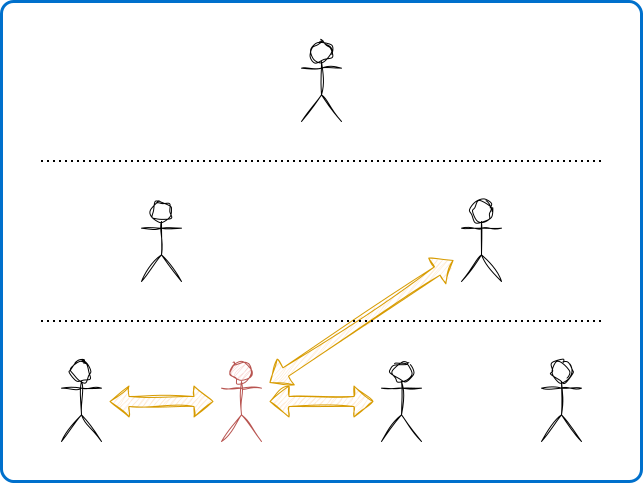
Hub communication also known as “wheel communication” is a communication pattern where all communication flows through a central figure or hub. This individual acts as a focal point for disseminating and receiving information to and from various members or departments within an organization. This type of communication can streamline decision-making and ensure consistent messaging.
Hub communication is a centralized mode of interaction in which information converges through one or more focal roles, functions, or systems that act as coordination points. This model reflects network‑like structures where certain actors serve as connectors or facilitators between otherwise distant parts of the organization.
In this context, hubs do more than simply pass information; they shape, filter, and orchestrate communication among participants. A well‑designed hub can enhance clarity, reduce noise, and support complex coordination across teams or departments. However, the effectiveness of hub communication relies on the competence and situational awareness of the hub role itself.
James Coplien’s work on organizational patterns, particularly the hub, spoke, and rim configuration, provides useful insight into how hubs function in real organizations. Through empirical studies of team communication networks, Coplien and his collaborators identified hub roles as central connectors that manage and balance the flow of information while reducing unnecessary direct links between every pair of actors, creating a social network optimized for coordination and productivity.
- A project coordinator managing cross team updates
- A product owner relaying priorities between engineering and stakeholders
- Software architects coordinating teams on design implementation and technical alignment without making final decisions
- Staff or Principal engineers acting as natural hub points connecting multiple teams and providing guidance
Common communication channels:
- Centralized dashboards or collaboration platforms
- Assigned liaison roles or coordinators
- Cross functional leadership committees
- Shared repositories of documentation and updates
- Reduces the number of direct communication paths needed, simplifying complexity
- Helps ensure consistency and alignment in messages across groups
- Facilitates coordination in large or distributed teams
- Can become a bottleneck if the hub is overloaded or unclear in responsibility
- Risks silencing informal channels and reducing autonomy if over‑centralized
- Dependence on the hub’s skills and tools means weak hubs can harm collaboration
Synchronous and asynchronous communication flows#
Once we understand the directions in which information can move, it becomes crucial to consider how it moves. In other words, the tempo and timing of communication, whether real-time or delayed, can greatly influence how effectively teams collaborate and make decisions.
Synchronous communication#
Synchronous communication happens in real time. All participants are present and engaged simultaneously, enabling immediate feedback and dynamic interactions.
- Team meetings or daily stand-ups
- Video or phone calls
- Instant messaging when everyone is online
- Decisions are made quickly
- Misunderstandings can be clarified immediately
- Builds personal connection and team cohesion
- Requires strict discipline: meetings should have a clear agenda, defined objectives, and necessary documents shared in advance
- Participants must read and prepare beforehand, which often does not happen in practice
- Can be disruptive to focused work
- Often leads to unproductive meetings when preparation or attention is lacking
- Not suitable for teams distributed across multiple time zones
- Difficult to scale: adding more participants or larger teams often reduces efficiency and interaction quality
Think of synchronous communication as a live conversation at a roundtable, fast, responsive, and collaborative, although it can be potentially inefficient without proper structure. Generally speaking, unnecessary meetings should be avoided, and synchronous interactions should be reserved for topics that truly require real-time engagement.
Asynchronous Communication#
Asynchronous communication occurs with a delay. Participants contribute at different times, often using tools that preserve context and documentation.
- Emails and newsletters
- Collaboration platforms (e.g., Slack threads, Confluence, shared documents)
- Project management updates
- Allows thoughtful, considered responses
- Flexible for team members in different time zones
- Reduces interruptions and supports focused work
- Supports scalability: easily accommodates larger teams without reducing efficiency
- Slower decision-making
- Risk of misinterpretation without tone or nuance
- Requires a strong culture and clear engagement: everything must be documented and shared consistently
- Generally more successful in mature organizations with established norms and disciplined information practices
Asynchronous communication is like sending letters in a network of post offices: the information travels steadily, reaches far, and is recorded. When done well, it can outperform synchronous approaches, but only if the organization has the maturity, discipline, and cultural commitment to make it work.
Finding the Right Balance#
Successful organizations blend synchronous and asynchronous flows. Urgent or highly collaborative topics often require synchronous communication, while complex problem-solving, updates, and knowledge sharing thrive asynchronously. Establishing clear norms, such as expected response times, documentation standards, and company-wide engagement, ensures that both forms of communication support efficiency, alignment, and employee well-being.
Synchronous meetings are powerful but risky. Without preparation, discipline, and focus, they often become unproductive. Asynchronous communication, when supported by a mature culture and clear documentation, is often the more efficient and sustainable choice.
Mapping flows to structures#
Understanding the different modes of communication within an organization is more than an academic exercise. Each flow shapes how work is coordinated, how information travels, and how teams interact. Recognizing the strengths and limitations of each mode allows leaders and engineers to design processes that are both efficient and resilient.
Communication patterns are closely tied to organizational design. The way information moves can either enable teams to collaborate effectively or create friction, bottlenecks, and misalignment. Observing who communicates with whom, and how, often reveals the informal networks that exist alongside formal hierarchies.
In the next article, I will present the main frameworks and common ways teams are split, providing a clear comparison to help you choose the team topology that best fits your organization’s needs and goals.
The first step in applying this understanding is to map the communication flows within your organization and clearly define through which channels each type of information should be transmitted. This mapping should be documented and shared with all teams to ensure everyone understands how information moves and who is responsible for relaying it. The goal is to avoid the two extremes: teams receiving too little information, leaving them uninformed, or too much information, which overwhelms them and makes it difficult to filter what is important.
In the next article, I will present the main frameworks and common ways teams are split, providing a clear comparison to help you choose the team topology that best fits your organization’s needs and goals.